June 22, 2026
Lexicon Inc. has become one of the first companies in the country to implement a robotics system that can fabricate large trusses and other complex structural assemblies, an upgrade the company says will mean hiring more welders, not fewer.
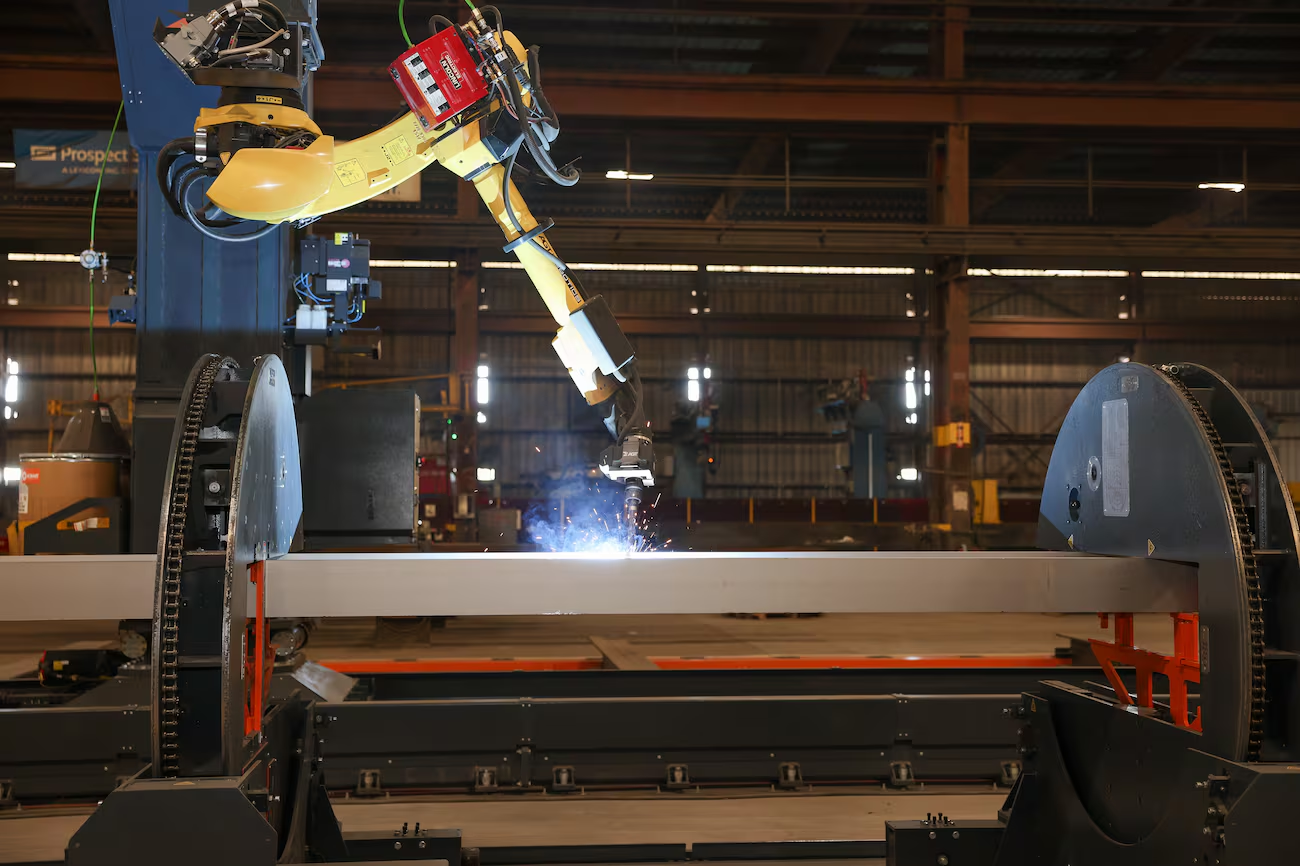
The Little Rock steel fabricator has installed an AGT Robotics BLOK 500 robotic welding system at its Prospect Steel division in Blytheville, adding to a robotics footprint the company began building a decade ago.
The new machine can outperform a human welder 4 to 1, yet adding robotics has not cost Lexicon any jobs, Chief Operating Officer Steve Grandfield told Arkansas Business in an interview.
“It means we need more welders, and we need more people to use our CNC (computer numerical control) machines, we need more painters and more people to load out, because it gave us the ability to push more production through the shop,” he said. “We’ve only continued to grow and add more people since we’ve added robotics to our shops.”
AGT, the Canada-based machining manufacturer that built Lexicon’s new system, estimates human production to be around eight hours per truss compared with robot production at around 2.75 hours per truss.
Using robotics to fabricate structures like trusses is gaining traction across the globe. Steel Industry News projects the North American steel industry will deploy 5,000 to 8,000 robotic systems between 2026 and 2027, representing $1.5 billion to $2.5 billion in capital investment across mills, distribution centers and automated logistics networks.
‘Three Buttons Later’
Lexicon installed its first robotic line in 2016 and now has several across its plants, but those machines handle smaller parts such as columns and standard beam framing. The new BLOK system is built for large structural weldments like the roof trusses, frames and girders used in stadiums, warehouses and steel mills themselves.
The BLOK machine offers full three-axis motion, including a plunging Z-axis that lets the robot drop into crevices a human welder would otherwise have to climb into to reach. It runs across multiple “zones” in the Blytheville plant, with one zone equipped with heavy-duty positioners capable of handling parts up to 25,000 pounds, and a second, more flexible zone that can handle fixtures or variable assembly types for a variety of jobs.
That setup allows teams to alternate between massive structural weldments and lighter, mixed-volume builds without retooling the line.
Lexicon completely customized the configuration with AGT. Grandfield said the line can run from $1 million to $2.5 million, with Lexicon’s configuration on the higher side of that range.
But the new system is also using artificial intelligence. Jimmy Stokley, vice president of production for Lexicon’s Fabrication Group, said that it’s just as much software as it is welding.
Once a fabricated piece is set in place — the system displays where each truss should sit on a numbered grid — welding begins within 10 minutes, and that timing is actually the “worst-case scenario” for the system, Stokley said.
The programming runs through AGT software called Cortex, which converts part models into images, mapping out each individual piece and every part that has a weld. Cortex then shows where the robot needs to weld, where the robot can’t weld, and where humans need to weld.
It also presents a percentage of welds that it can and can’t make.
“Literally three buttons later, it’s welded,” Stokley said. And everything is based on that part model. Stokley said the model is “perfect,” and that Lexicon wants everything it fabricates to be as close to the model as possible.
So the AGT system has a SnapCam vision system that takes photos once a part is in place. With the photos, the software adjusts to any minor misfits from the model, and will change the programming of where welding beads need to go.
That is much faster and accurate than old systems, and it’s able to spot things the human eye might not be able to, Stokley and Grandfield said.
“The robot doesn’t fatigue. It doesn’t get tired,” Stokley said. “If you were to take two identical pieces and put one in front of a very good welder, which we have, and you put one in the robot, you’re going to probably see that the robot will outperform 4 to 1.”
The AGT BLOK 500 joins several other robotics lines already in place in Blytheville, including a Zeman welder and a Zeman Enspector, which scans parts for quality checks and sorting. The company also has a Zeman system in Little Rock. Back in 2016, those systems cost between $2 million and $3 million, Grandfield said.
The BLOK 500 is already running large roof trusses bound for the Austin Convention Center in Texas, Stokley said, pieces roughly 40 feet long and 13 feet wide. Production started on the line in March, and Grandfield said Lexicon begins seeing significant gains within a couple of months after installation.
Grandfield said the return on investment of robotic systems at Lexicon is “very fast,” between one to two years. He also said that Lexicon’s shops adopt the technology fast and are continually looking at ways to improve on it.
Since Lexicon introduced robotics in its fabrication group in 2016, the company has increased its capacity of fabricated structural steel by 400%. Grandfield said faster, cheaper fabrication also helps make steel a more attractive option for building owners weighing it against other materials.
The robotics also reshape how Lexicon competes for work. Stokley said the labor and material savings can be passed to customers, potentially winning bids over competitors without the technology. The speed has also compressed timelines, Grandfield said. The company has roughly halved the schedule it once needed to fabricate and erect the steel for multimillion-SF projects.
“It’s made us a better company,” Grandfield said. “It’s really forced us to look at all aspects of our fabrication shop to streamline the process, and to feed our robotic system and feed our fitters and welders on the shop floor. That in turn has increased our throughput and what we can produce pretty dramatically.”
The robotics expansion has been partially driven by the skilled labor shortage, but has also been a way for Lexicon to train its workforce in new ways.
The BLOK system reduces the amount of manual heavy welding required, enhancing safety and creating opportunities for team members to grow into higher-skill operator and robotics roles.
“It’s not a sophisticated, complicated process to onboard to run these robots, and that’s the way it’s intended,” Stokley said.
When Lexicon first installed its Zeman line, employees worried the robots would cut jobs, but the workforce actually doubled. And the company said that although it’s still in the early stages of implementing the AGT system in Blytheville, it does expect the employee headcount to go up because the system allows for more production.
“We will never get away from human welders,” Stokley said. “That’s never going to stop.”