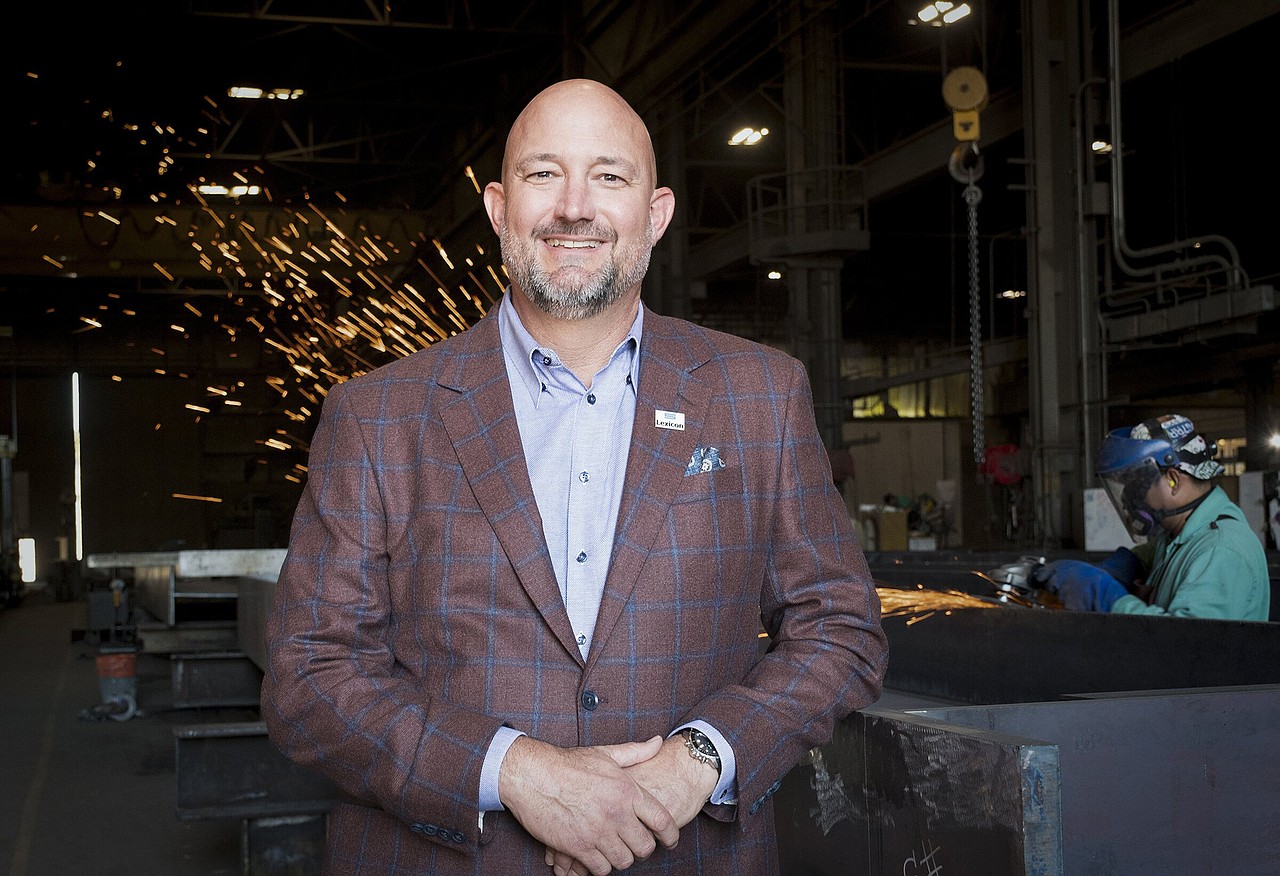
Patrick Schueck has beaten cancer three times and transformed that experience into a lifeline for his employees
He does right, thinks big and, most importantly, shows up
In 1991, freshman walk-on Patrick Schueck reported for his first basketball practice at Arkansas State University at Jonesboro. A few months earlier, he’d been wowed by the school’s facilities, including what he considered the luxe locker room, and he’d eagerly looked forward to moving-in day.
“I walked into the locker room and I go around to each one of the lockers. I don’t see my name,” he says. “I found one of the managers and I’m like, ‘Hey, I went around and looked, there’s not a locker.’ He started laughing and said, ‘Oh, you got a chair,’ and then I see two chairs over in the corner.”
Schueck dutifully fell in line with what he thought was merely a locker shortage. It wasn’t until attrition started setting in he learned the real reason he was dressing on a chair when everyone else was dressing out of a locker.
“When kids started quitting there were lockers available, so one day I put my stuff in one of them. Well, I got in trouble,” he says. “They said, ‘Those lockers are for scholarship kids not for walk-ons.’ So, for a year, everybody had a locker and I had a chair. The next year started and there were two free lockers. I still had the chair.”
At this Schueck leans forward, his jovial storytelling turning gravelly.
“I’d look at that chair every day,” he says, “and I can remember looking around that room thinking whose a** I was gonna kick that day. Who am I going after today? Whose job can I get today? That chair became a motivating factor.
“Anyway I did really well that second year, got a lot of minutes and I earned a scholarship. I remember walking in and that equipment manager had moved my stuff to a locker. I’m like, ‘Why’d you move my stuff?’ He said, ‘Because you’re a scholarship athlete now.’ I said, ‘You can shove that locker up your a**. I want my chair.'”
At this, the lightness returns to Schueck’s tone and he leans back into a laugh. He has told the story a thousand times, on some occasions just re-running it in his head as he has faced challenges in his life from relationships and health to running the family construction business, Lexicon. His story is a testament to doing right, thinking big and, most importantly, showing up.
“I talk about hope a lot and how today, there’s not enough of it,” he says. “We’ve got a lot of people that walk around not understanding or fulfilling their true purpose. I truly think when people don’t realize their purpose they flutter through days without being present to what they’re doing, without being present to their families, without being present to the things that truly matter.
“It’s our job as leaders, as community leaders, and individuals to make sure people realize there’s no reason for that line of hope to go below that line of reality. I believe in that, and that draws me to what I do in the community. It pushes me to give back and it pushes me forward to do the things I do.”
HARD WORK
Patrick Schueck was born the youngest of two children, the only son of Marge and the late Tom Schueck. Though he described his upbringing as idyllic, it was also punctuated with the challenges of the unbending code set down by his father for achievement and excellence.
“Hard work was number one and he parlayed it in a couple different ways,” he says. “Schoolwork, obviously, and in athletics. Are you putting in the time? Are you doing everything it takes to be the best? Hard work was definitely in our creed growing up.”
Tom’s success as a businessman — he founded Schueck Steel Products in his garage in 1968 and grew it into multiple steel and construction subsidiaries — stemmed from unrelenting intensity and ambition. Patrick wholly admired his dad and still does, even while admitting to being two very different people.
“Dad had an inner core that always wanted to do more, and he was really driven by that to the point he had tunnel vision. He was going to get there and by God, he got there, usually before everybody else,” Patrick says. “I’m driven too, but differently. I think deeper, I’m more strategic. I’ve seen the collateral damage that can occur when you approach things with the kind of passion that doesn’t care about anything outside those lines. That’s where he and I really differed.”
Patrick credits the influence of his mother for helping him develop his own brand of ambition and tenacity.
“She was able to give me the confidence I needed to get through things,” he says. “She gave me the patience to understand everything has to run its course and things will work out. She gave me the strength to know everything happens for a reason and at the end of the day we will be better because of it.”
All that said, people who knew Patrick growing up, such as Dallas Cowboys owner Jerry Jones, saw ample “Schueck drive” in him.
“I’ve known Patrick since he was just starting junior high,” Jones says. “We were neighbors for years and years in Little Rock, and I had a basketball goal mounted on the outside wall of our house, the very wall that backed up to my bed. As Patrick got older, taller and more serious about basketball, he was out there every hour of the day it seemed, shooting by himself.
“He’d bounce that ball off the wall — my wall — like a pass back to himself and then turn around and hit his jumper. Many nights Patrick was why I missed a lot of good sleep, but I was so excited watching him develop and I was so proud of his potential that I never once ran outside to tell him to stop. I knew even then he was becoming something special.”
At Catholic High, Schueck encountered another major influence in the late Father George Tribou, principal and rector. Tribou not only held the youngster to the school’s high academic standards but further sanded the edges of his intensity by preaching servant leadership.
“Father Tribou was very important to me; he played a major role in my life,” he says. “He was the first real intermediary between me and my dad. I had a lot of great conversations with (Tribou) and I really miss him.”
THE BIG C
Then came A-State and the story of “The Chair” and its role propelling Schueck from faceless freshman to seasoned upperclassman. By then studying engineering and poised for great things on the court, he was dealt a blow that would take more of the trademark Schueck grit than basketball ever did. Through his annual school physical, an abnormality was detected that proved cancerous. Informing his parents, he was summoned home.
“By the time I got home, they already had a plan,” Schueck says with a grin. “That’s just how they operated.”
Schueck was treated by the late legendary Little Rock urologist Dr. Mack Moore and Dr. Lawrence Einhorn — later to achieve fame as Lance Armstrong’s oncologist — who he continues to see annually. It is here he shares one of the more unconventional insights he gained through the chemo and the surgeries and duress of being a cancer patient, in his case three separate times.
“When I look back at the things that shaped Patrick, going through (cancer) was probably the single most important thing in my life,” he says. “One of my biggest pet peeves is when people say living through cancer is an accomplishment. It’s an opportunity. You get an opportunity to do things again. You got an opportunity to make a difference.
“Cancer takes a lot of away from you; it makes you stop believing, it turns the world to gray, makes you grumpy, makes you angry. At the same time cancer makes you love harder, it makes you see the color through the gray, it makes you understand what’s really important to you. So when I say it’s an opportunity, it was an opportunity for me to understand all these things better.”
PICKING UP TRASH
Despite his pride in the family business and a bone-deep love for his hometown, coming to work for, let alone lead, the firm was never a given. After finishing his degree at the University of Arkansas, Schueck initially headed for Dallas and was lured back some time later by a job offer from Nucor Steel in the northeastern part of the state. It was an offer that, in a famous piece of family lore, Tom flatly forbade.
“He was like, ‘I’m not gonna let you do it. You’re not doing it. You’ll come to work for me.’ I said, ‘I don’t wanna work for you,'” he says. “My mom finally said, ‘You need to go work for your dad.’ Plus, he made me an offer I couldn’t refuse, like, $44,000.”
Schueck would earn every penny of that, starting in South Carolina where his first assignments left no doubt he wouldn’t be trading on his name.
“My first job was picking up trash,” he says. “My second job was taking a bushing gun to column bases which is basically jackhammering for 10, 12 hours a day. I stomped around in the mud, swept floors, pulled wire, unstuck bolts, everything.”
Asked why, knowing he could land more comfortable work virtually anywhere in the country, he stuck it out at the bottom of the food chain, Schueck simply says, “I learned more there than I’ve ever learned in my entire life.”
“I was working for a man named Gene Riley,” he says. “Gene was a born leader who could get a group of men to run up a muddy hill in snow, lightning and rain at the same time. Gene had the approach to leadership that it takes every one of us to get it done.
“He knew me from a child, so he knew there was no quit in me, and if the others saw me picking up trash or bushing columns it would motivate everybody else knowing I’m no better than anybody out here. He was also making sure that I understood what it took for a company like ours to be successful, which was everybody pitching in, everybody pulling from the same end of the rod.”
The strategy invested in the future company boss an invaluable understanding of and genuine respect for the tradespeople around him.
“I learned everything about people and the most important thing that I learned was being a college-educated engineer didn’t make you anywhere close to the smartest person in the room,” he says. “I worked with some of the most intelligent, high-IQ individuals you’ll ever meet in your entire life doing work that far exceeds anything I ever calculated or computed in college.
“That’s no slight to the University of Arkansas, it’s just a fact that for these guys, their trade educated them in a capacity that, in some circumstances, there’s no way in hell I’d be able to comprehend.”
Schueck also saw up close the toll the work demanded of employees. When he took over company leadership after Tom’s death in 2020, he’d implement programs establishing a company-sponsored medical clinic and access to mental health resources, perks largely unheard of in the industry.
“I learned how hard it is to be on the road away from your family, trying to get a job done, trying to make a paycheck,” he says. “I saw how hard it is when you’re sick to be on the road, to find time to get to the doctor or find a pharmacy that’ll take out-of-state insurance. I saw how a lot of our guys just worked sick because they couldn’t take days off.
“That really propelled us to take a deep look internally on how we can make the lives of our employees better. The more we invest in them the better because we are actually supporting the people that really help run the place.”
“When you look at the commitment Patrick has made to his team, you see an act of deep, personal empathy not just executive strategy,” says Marcie Doderer, president and CEO of Arkansas Children’s Hospital for which Schueck has served as a board member since 2013. “As a cancer survivor, he knows firsthand how critical it is to have immediate access to care, and he’s transformed that experience into a genuine lifeline for his employees and their families. He knows the difference an accessible doctor or a mental health resource can make.
“Patrick views leadership as a responsibility to lift others up, proving that true business success is inseparable from the health and resilience of the people who build it every day.”
EXTRAORDINARILY GENEROUS
The success of the company has allowed more investment in future employees as well. A major force behind the Academies of Central Arkansas, which exposes high school students to various careers and tailors a curriculum accordingly, Lexicon has funded a welding program at Wilbur D. Mills University Studies High School. Schueck grins broadly as he tells of how some youths have gone from chronic truancy and behavior problems to model students because of the program.
He’s also served on a broad range of boards and committees, the better to improve quality of life in the community that grew Lexicon and that its employees call home. In this work, he has gained a reputation for generosity and can-do ethic.
“I’ve known Patrick indirectly probably 20 years,” says Dr. Dean Kumpuris, physician and serial community activist. “His father was a friend of mine and I’ve worked with Patrick for the last 10 or 15 years doing different things for the city. He is extraordinarily generous with what goes on. He’s the type of guy you can just call up and say, ‘I need to get this done,’ and he says, ‘Sure, fine,’ and gets it done. It’s not ‘if’ and ‘or,’ it’s just, ‘When do you need it and where do I deliver it?'”
Schueck is proud of all that has been accomplished if far from satisfied. His tone turns biting when he talks of the need for more state and federal funding for skilled career training and even though Lexicon’s mental health program has been in his words, “a tremendous success,” he can’t abide the ones that got missed.
“We lost an employee this year to suicide, and I am very upset about it,” he says. “After everything that we have done, there’s still people that are hurting. I’ve had my own struggles. Nobody really talks about their bad days and their dark days, but when we walked down this path as a company, it said that we were willing to talk about it and help others talk about it. Frankly I don’t care how much we spend because if we help one person it’s paid for itself.”
Schueck’s multi-faceted career has lost nothing of its drive to expand and achieve. Lexicon is poised for more growth in the near future, harnessing cutting-edge technology including robots and AI to help its employees be more productive without sacrificing quality or safety. His stated goal is to become “the world’s largest mom-and-pop construction company” and if history teaches anything, it is to not bet against him.
“My biggest concern is I’m going to get to the Pearly Gates and St. Peter’s gonna look at me and tell me I fumbled. I don’t want have that conversation so we’ll go as hard as we can, as long as we can and do what we can to make a difference,” he said. “There aren’t enough people who think tomorrow’s going to be better than today, but I believe that. I think my best day ever is tomorrow.”
SELF PORTRAIT
Patrick Schueck
FAMILY: Spouse, Jessica; children Mason (21), Ava (18), Hayden (18), Whitten (12)
MY FAVORITE CHILDHOOD MEMORY IS: Saturday night dinner at Scully Point on Lake Hamilton.
SOMETHING FEW PEOPLE KNOW ABOUT ME IS: I carry a copy of Rudyard Kipling’s poem “If” everywhere I go.
I’VE NEVER BEEN AFRAID TO: Meet new people.
ONE THING I’VE YET TO ACHIEVE: My absolute best.
AT A FANTASY DINNER PARTY I WOULD LOVE TO: Get the band back together again — Tom Schueck, Jerry Lamb, Jerry Jones, Don Tyson and Billy Moore.
THE PEOPLE WHO INFLUENCED ME THE MOST ARE: My mom and dad.
THE PEOPLE I WOULD LOVE TO MEET ARE: Both of my granddads.
THE BEST ADVICE I EVER RECEIVED WAS: “Play the hand you are dealt” by my dad.
IF I’VE LEARNED ONE THING IN LIFE, IT’S: The sun will come up tomorrow and tomorrow will be better than today.
THE ONE WORD THAT DESCRIBES ME: Passionate.